 Digital Peax
 Google is auto-upgrading Search campaigns to AI Max on September 1
 By
By 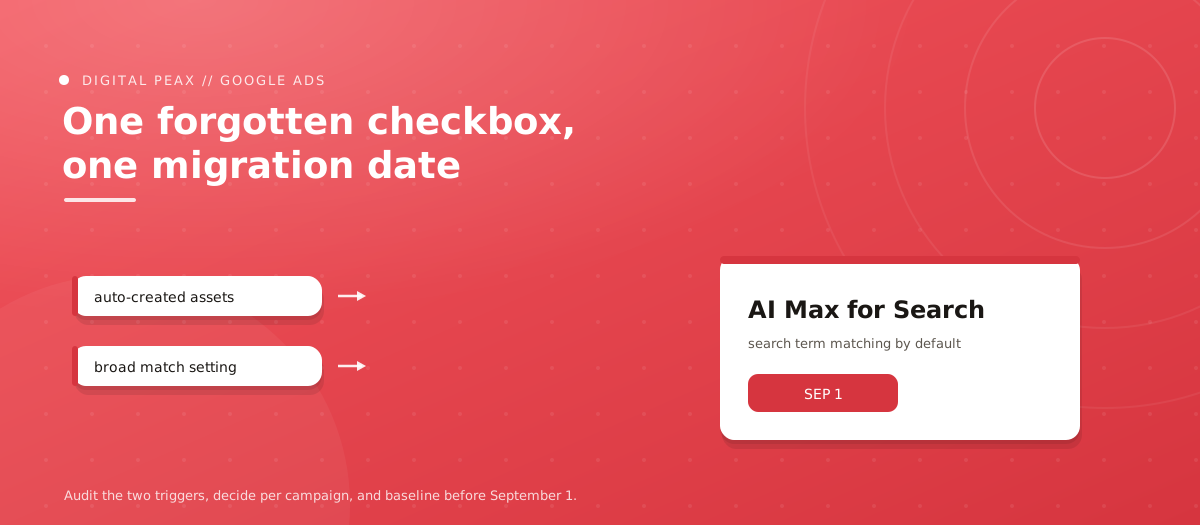
If you have not audited which of your Search campaigns use automatically created assets, do it this week. On September 1, Google begins automatically upgrading those campaigns to AI Max for Search, along with any campaign using the campaign-level broad match setting. Google emailed affected advertisers on August 5, and the only way out is to turn the legacy setting off before the date.
Google emailed affected advertisers on August 5, with wording that leaves little ambiguity: campaigns using automatically created assets and/or the campaign-level broad match setting will automatically be upgraded to AI Max for Search campaigns. This matters more than the usual forced-upgrade notice because the trigger is a setting most people forget they enabled. Automatically created assets is a checkbox that has been quietly on in a lot of legacy Search campaigns since it rolled out. It is not a campaign type. Nobody reviews it. And it is now the thing that decides whether your campaign changes its matching behavior next month.
What actually changes, per campaign type
The two triggers do not produce the same outcome, which is the detail most coverage is glossing over.
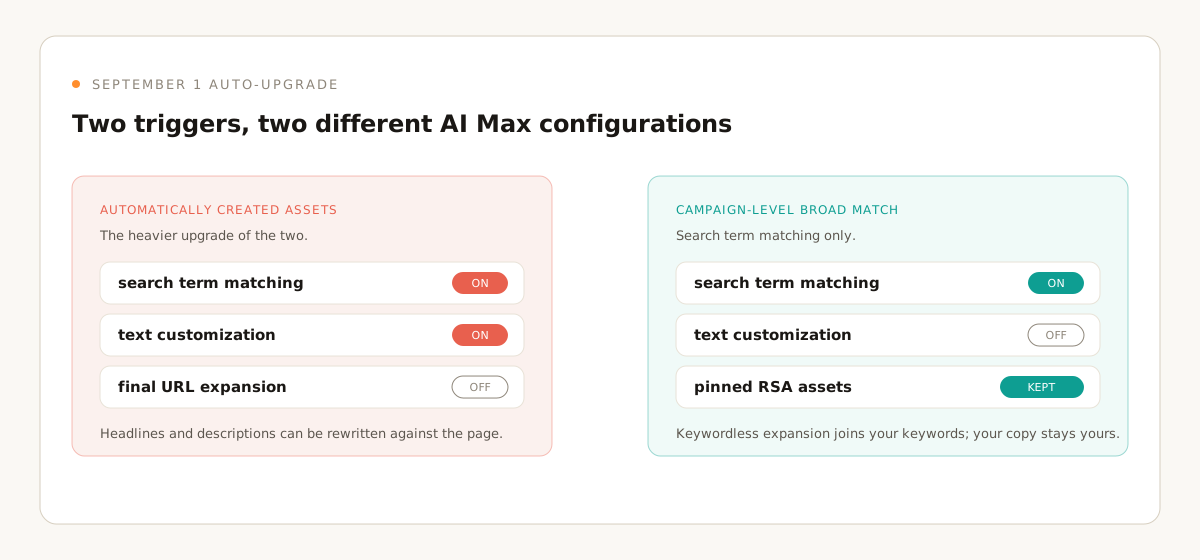
Campaigns caught by automatically created assets get AI Max with search term matching and text customization enabled by default. That is the heavier of the two. Text customization means Google can rewrite headlines and descriptions against the landing page. Search term matching means keywordless query expansion on top of whatever keywords you already have.
Campaigns caught by campaign-level broad match get search term matching only. Text customization and final URL expansion stay off. Pinned responsive search ad assets continue to be respected, which is the one genuine reassurance in the announcement for anyone running compliance-sensitive copy.
Google frames the rollout as preserving existing campaign behavior as closely as possible by applying AI Max settings that mirror current configurations, as reported by Search Engine Land on August 6. Read that carefully. Mirroring your configuration is not the same as producing the same query mix. Automatically created assets already wrote copy; it did not expand your matching. Search term matching does.
The DSA deadline moved, this one did not
Worth separating these, because they are being conflated. Google extended the Dynamic Search Ads sunset and auto-upgrade to February 2027. If you run DSA, you got five extra months. If you run automatically created assets or campaign-level broad match, you did not. Your date is still September 1.
Google's own figure for AI Max is an average of 7% more conversions or conversion value at similar CPA or ROAS when using the full feature suite, per the same announcement. Treat that as a vendor number measured across a population that opted in voluntarily. It tells you the feature is not broken. It does not tell you what happens to a specific account that gets migrated without choosing to. We made the same point in running AI campaigns without losing control: a platform average is a reason to test, not a guarantee to bank.
The opt-out is real, and it is a setting change
You are not stuck. Two paths, per PPC Land: turn off the legacy features before September 1, or enable AI Max yourself now so you control the configuration rather than inheriting the defaults. Google recommends the second. For most client accounts the honest answer is that it depends on how much your current query mix is doing work the client's brief actually cares about. On tightly controlled lead-gen campaigns with a clean negative list, we turn the legacy setting off. On campaigns already running loose match with healthy volume, we enable AI Max manually and set the defaults ourselves.
One operational trap worth flagging: final URL expansion replaces your URLs with dynamically selected landing pages, and on automatically created assets campaigns it only applies if you enable it afterwards. Tracking templates built with nonstandard constructions can produce 404s when the URL changes underneath them. If your tracking template does anything clever with the final URL, test it before you enable anything.
Reporting is better than it was
Credit where it is due. The upgrade brings reporting that makes the change auditable rather than opaque: a search terms report with an AI Max match type designation, a source column that distinguishes broad match expansion from keywordless matching, AI Max summary rows in the keywords report, and a selection source column in the landing pages report. That last one is what you need to catch final URL expansion sending traffic to pages you would never have chosen.
Two more dates on the August calendar
August 17 is the other date to circle. Google's bidding target optimization change lands then, affecting budget-limited campaigns on Target CPA or Target ROAS. Campaigns that have been quietly overdelivering against their stated targets will start optimizing toward those targets more literally. If your targets were set two years ago and never revisited, they are about to become real.
One genuinely good piece of news from the same week: Google Ads added dedicated new customer acquisition reporting, with new customer and new customer value columns available without touching bidding. That kills the widely used hack of setting a 0.01 new-customer bid multiplier purely to unlock the reporting. Measurement is now separate from optimization, which is how it should have been all along.
The whole decision in one line: campaigns not running automatically created assets or campaign-level broad match are unaffected. For everything else, you either turn the setting off before September 1 or you choose the AI Max configuration yourself instead of inheriting it.
What to do this week
- Run an account-wide audit for the two triggers. Filter Search campaigns for automatically created assets and for the campaign-level broad match setting, and export the list per client. Campaigns not on that list are unaffected.
- Decide per campaign, not per account. Controlled lead-gen with a clean negative list: turn the legacy setting off. Loose match with healthy volume: enable AI Max manually and set the defaults yourself.
- Baseline before the date. Save a 28-day snapshot of CPC, impression share, search terms count, and cost per conversion for every campaign on the list. Without it you will spend September arguing about whether anything changed.
- Test tracking templates against final URL expansion on any campaign where you might enable it later, and verify the template resolves on a landing page you did not pick.
- Review Target CPA and Target ROAS values before August 17. Pull the last 90 days of actual CPA against stated target; anywhere actual is meaningfully better, the target is wrong and about to start costing you efficiency.
None of this requires panic. It requires a list, a per-campaign decision, and a baseline, all before September 1. Running that kind of migration without losing a client's query mix is the day-to-day of our performance marketing services.
Sources
- Search Engine Roundtable: Google Ads to migrate campaigns to AI Max on September 1
- Search Engine Land: Google to auto-upgrade some Search campaigns to AI Max
- PPC Land: Google Ads broad match campaigns face AI Max auto-upgrade on September 1
- Google: Upgrade to AI Max, Dynamic Search Ads timeline
- Search Engine Journal: Three Google Ads bidding and budgeting updates
- Search Engine Land: Google Ads adds dedicated reporting for new customer acquisition
The Peax Brief
One sharp idea on data-driven growth, every other week. No spam, unsubscribe anytime.