 Digital Peax
 The August spam update is finished. Here is how to read it without breaking anything.
 By
By 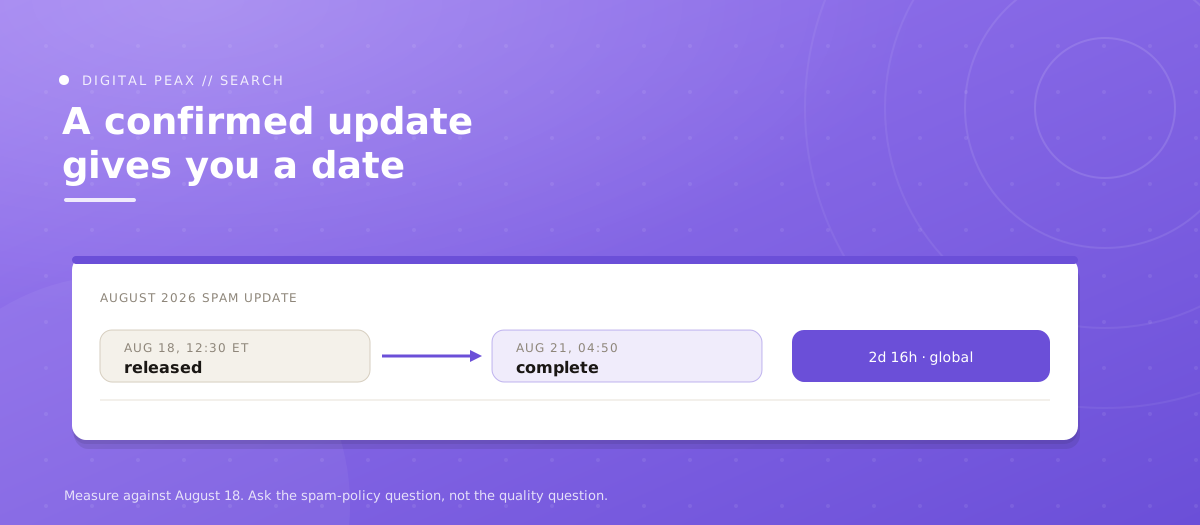
Google released the August 2026 spam update on August 18 and finished rolling it out on August 21, two days and sixteen hours later. It is global, it covers all languages, and it is the third spam update of the year. It is also confirmed and precisely dated, which is rare. After seven weeks of unexplained volatility, that date is the most useful thing search has given us this summer.
Get the timings exactly right, because the whole value of this update is that you can date it. Google announced the release on Tuesday August 18 at around 12:30pm Eastern and posted completion on August 21 at around 4:50am, a rollout of about two days and sixteen hours (Search Engine Roundtable, Search Engine Journal). It applied globally and to all languages, Google described it as a normal spam update, and periodic refreshes will follow. There was no accompanying blog post for either note.
Compare that with the two unconfirmed volatility spikes that opened the month. For most of the summer, sites moved and nobody would say why, so there was no clean line to measure against. Now there is one: a start, an end and an official label.
Spam update, not core update, and the difference decides your response
A core update reassesses relevance and quality across the index. If a legitimate site drops in one, the guidance is genuinely to improve the site and wait, because nothing was flagged as a violation. A spam update works differently. It targets content and behaviour that break Google's published spam policies. These are enforcement systems, not quality judgements.
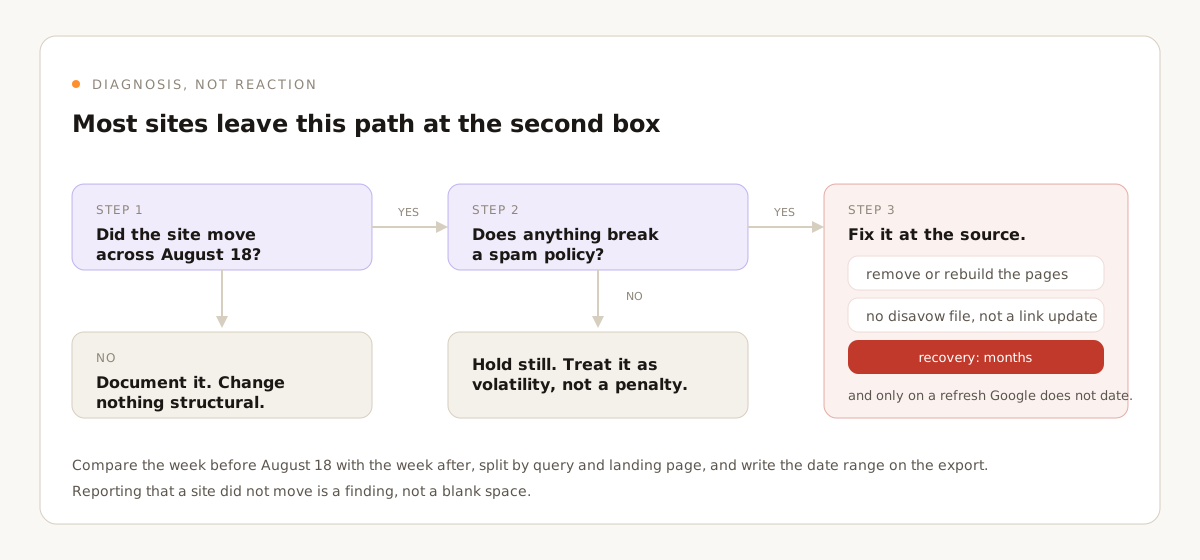
So after a drop, the first question is not whether the content is good enough. It is narrower and less comfortable: does anything on this site break a spam policy? Scaled content produced primarily to rank rather than to help a reader, cloaking, sneaky redirects, expired-domain abuse, link schemes. If the honest answer is no, the drop probably is not about you, and the correct action is to hold still.
What this update is not, which narrows the diagnosis usefully
Two exclusions are worth stating because they close off the two most common wrong turns. This is not a link spam update: if traffic fell on August 18, the backlink profile is not the first suspect and a disavow file is not the response. And it does not carry the site-reputation-abuse policy, so the parasite-SEO enforcement lane gets no special weight here.
Past that point, be careful. Google has not said which spam systems changed, so any confident claim that the August update went after AI content, or affiliates, or expired domains is a guess. Community reports do skew toward high-volume AI-written content taking damage, and that is worth knowing, but a forum pattern is a hypothesis, not a finding. Work from the published spam policies and from what you can observe in the account in front of you.
The honest thing to say about recovery
If a site did cross a line and you fix it, the recovery clock is long and it is not yours to control. Spam enforcement lifts on real fixes plus a subsequent evaluation, and Google has said periodic refreshes will follow this update without dating them. Practitioners who have worked through previous spam updates describe recovery in months, not weeks.
So give the client the plan, not a date: here is what we think broke a policy, here is what we are removing or rebuilding, and recovery depends on the next refresh, which Google does not announce in advance. Promising a timeline you cannot influence is how a fixable problem turns into a lost account.
The audit this is a good excuse to run
For most client sites doing ordinary, honest work, the right action this week is close to nothing. That is a real answer. If you make ten changes while the index is still settling, you learn nothing from any of them, and false positives do happen, so a short dip is not proof of a problem.
But the update is a reasonable forcing function for a review that most teams are overdue. Two years of AI-assisted publishing at scale has left a lot of sites full of pages that exist to rank rather than to be read. The line between helpful scaled content and scaled content abuse is the line spam updates enforce. If a client has a few hundred thin, templated, lightly edited pages sitting there, look at them now, on your own schedule, while a news event justifies the time. The alternative is a future update making the decision for you.
The rule in one line: a confirmed update gives you a date, and a date gives you a diagnosis. Measure against August 18, ask the spam-policy question instead of the quality question, and change nothing on the sites that did not move.
What to do this week
- Establish movement before anything else. Compare the week before August 18 with the week after in Search Console, split by query and by landing page, and write the date range on the export so nobody re-reads it later against a different window.
- For sites that did not move, do nothing structural and say so explicitly in the monthly note. Stability through a global spam update is a finding worth reporting, not a blank space.
- For sites that did move, diagnose against the spam policies specifically. Skip the disavow file and skip the generic quality checklist until you have answered the narrower question of whether anything here breaches a policy.
- Pull an inventory of high-volume, low-effort pages across the portfolio, ranked by how little a human would miss them. Improve, consolidate or remove, and start with the pages that only exist to rank.
- Give clients structure instead of a timeline. Name the suspected cause, name the fix, and say plainly that recovery depends on a refresh Google does not schedule in public.
Reading an update well is mostly about not acting on the first day, and being willing to ask the narrower question when a site really did move. That, plus the content work that makes a site worth citing in the first place, is what our SEO and GEO services are built around.
Sources
- Search Engine Roundtable: Google August 2026 spam update is done rolling out
- Search Engine Journal: Google finishes rolling out the August 2026 spam update
- Search Engine Land: Google releases August 2026 spam update
- Google Search Central: Spam policies for Google web search
- Google Search Central: Google Search ranking updates
The Peax Brief
One sharp idea on data-driven growth, every other week. No spam, unsubscribe anytime.