
A social media strategy that survives a budget review
 By
By 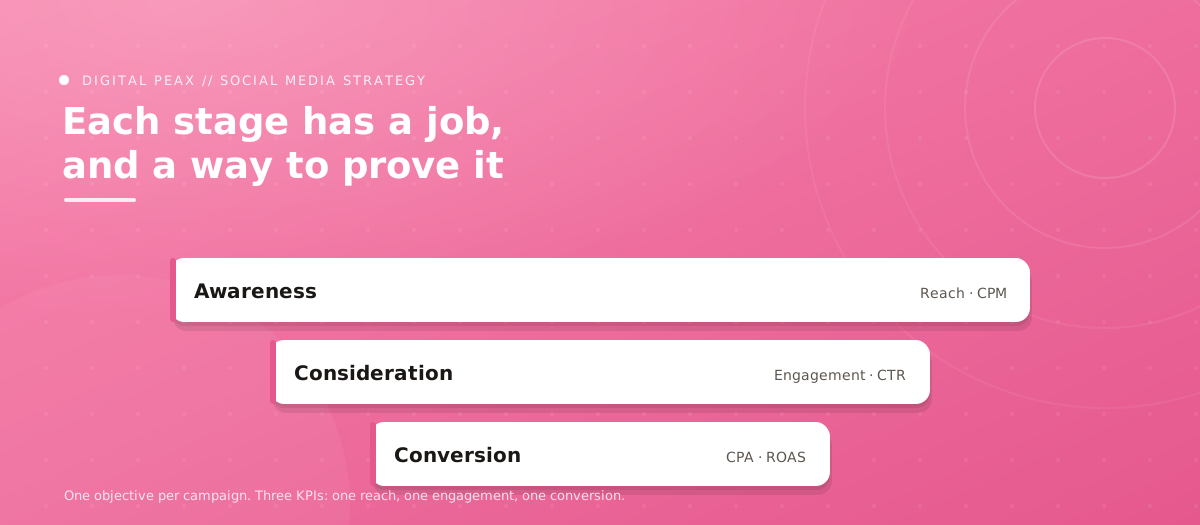
Most social media strategies fall apart the moment someone asks what the spend returned. Likes went up, reach went up, and nobody can say whether any of it sold anything. A strategy that survives a budget review starts from the opposite end: pick the objective, pick the campaign type that serves it, and pick the three metrics that prove it worked. This is the framework we set up for a business.
Social platforms will happily sell you motion that looks like progress. Impressions climb, follower counts tick up, a post "goes off", and none of it answers the only question that matters in a budget review: did this bring in customers? The strategies that survive that question are not the ones with the prettiest dashboards. They are the ones built around clear objectives and a short list of metrics that map to money. This is the framework we set up for businesses.
One objective per campaign
The first discipline is the hardest: decide what a campaign is for and refuse to ask it to do two jobs. A campaign optimised for reach and a campaign optimised for purchases are tuned by the platform in completely different ways, with different people, placements, and bidding. When you blur the two ("brand awareness, but also some sales please"), the algorithm optimises for neither well. Set one outcome-level objective per campaign: either you are buying attention or you are buying action.
Match the campaign type to the funnel stage
Both Meta and TikTok organise campaign creation around objectives that line up with the funnel. The trick is choosing the one that matches where the audience actually is, not the one whose number looks best in a screenshot.
Awareness: buy attention efficiently
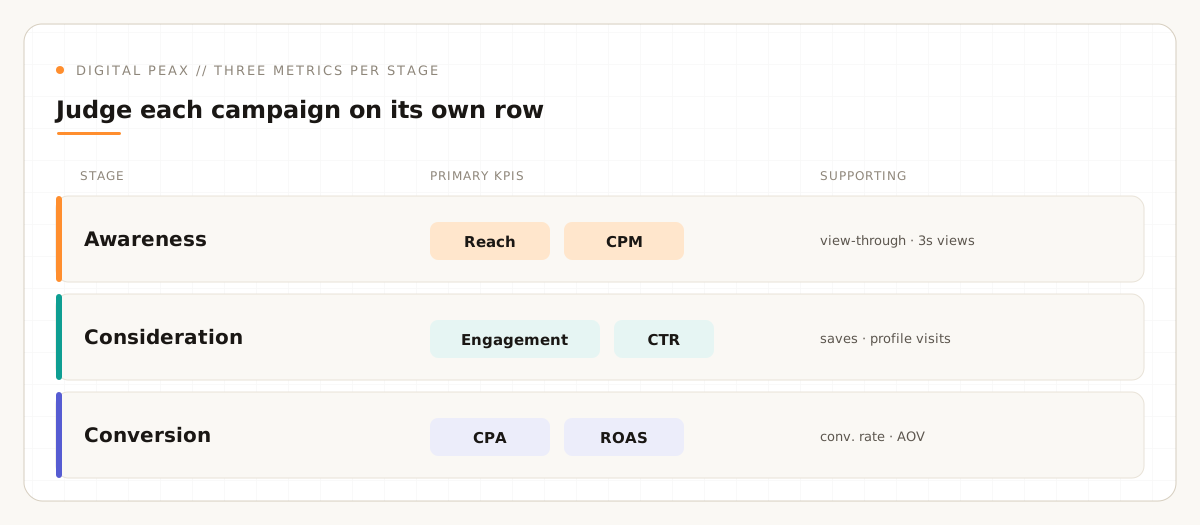
At the top, the job is to put the brand in front of the right people for the lowest sensible cost. Use reach and video-view objectives. Judge them on reach and CPM (cost per thousand impressions), supported by view-through and three-second views. Do not judge them on conversions. That is not what they are tuned to produce, and punishing an awareness campaign for a weak ROAS just teaches you to stop doing awareness.
Consideration: earn a signal of interest
In the middle, you want evidence that people care: clicks to the site, saves, profile visits, watch time. Use traffic, engagement, and video-view campaigns. The metrics that matter are engagement rate and click-through rate (CTR), with saves and profile visits as a read on whether the content is genuinely useful rather than merely scrolled past. This is the stage where creative quality shows up first in the numbers.
Conversion: buy action and prove it
At the bottom, you are spending for leads and sales. Use sales, leads, or app-promotion objectives with the pixel or the Conversions API feeding results back. Judge on cost per acquisition (CPA) or ROAS, supported by conversion rate and average order value. This is the only stage where a revenue number is a fair test, and the stage where measurement has to be airtight, which we will come back to.
The three-metric rule
For any campaign, define exactly three KPIs before launch: one reach metric, one engagement metric, one conversion metric. Three forces a hierarchy: a primary number the campaign lives or dies by, and two supporting reads that explain why. It also kills the endless dashboard of vanity figures that make reports long and decisions slow. If a metric will not change a decision, it does not belong on the scorecard.
The honest counterpart to that rule is naming the vanity metrics out loud. Follower count, raw impressions, and total likes feel good and rarely predict revenue. They are worth watching as health indicators over months, not as the score of a campaign that is supposed to sell something this quarter.
Creative is the real targeting
As platforms hand more audience selection to AI, and Meta's Advantage+ audience is the clearest example, the lever you still fully control is the creative. On a feed where the algorithm decides who sees what, the ad itself is what qualifies the audience: a thumb-stop that speaks to the right person is doing the targeting that manual settings used to. That is why we run social as a testing engine: a steady stream of hooks, formats, and angles, with enough budget behind each to read a real signal, and fast retirement of whatever fatigues. CPMs stay honest when the creative stays fresh.
Measure where the numbers survive scrutiny
Every platform grades its own homework. Meta, TikTok, and the rest each count conversions in their own attribution window, and those windows overlap, double-counting across platforms and against your other channels. For anything that touches revenue, the source of truth has to be your own analytics, with conversions defined as key events in GA4 and a server-side signal closing the loop. The platform dashboard is fine for optimising a campaign in flight. It is not the number you put in front of a CFO. We cover that measurement layer in our GA4 setup.
Decide the objective, choose the campaign type that serves it, and prove it with three metrics, one of which is a conversion measured in your own stack. Everything else is decoration.
Building the plan
- Set one objective per campaign and pick the matching platform campaign type.
- Define three KPIs up front: one reach, one engagement, one conversion.
- Run awareness, consideration, and conversion as separate line items, judged on their own row.
- Treat creative as the targeting layer and test it continuously.
- Confirm every conversion in your own analytics before it counts.
There is nothing clever in any of this. It is social media run like a budget line instead of a popularity contest, which is exactly what makes it defensible when someone asks what it returned. It is also the exact framework our performance marketing team runs on client social accounts.
Sources
The Peax Brief
One sharp idea on data-driven growth, every other week. No spam, unsubscribe anytime.